Elections: CBSE Class 9 Politics practice questions
Practise 50 questions on Elections, free, with an explanation for each answer.
Sample questions
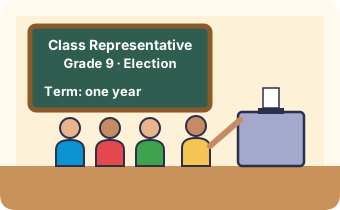
Gurmat was elected class representative (CR) in Grade 8. Now the class is in Grade 9. Can she simply carry on as CR without facing a fresh election?
- Yes. Once elected, a representative may stay on for as long as she likes
- Yes, as long as the class teacher agrees
- No. Representatives must face periodic elections, so the people they speak for can hold them accountable
- No, because a student is allowed to be CR only once in school
Show the answer
C. No. Representatives must face periodic elections, so the people they speak for can hold them accountable
The chapter answers this case with a clear No. Elected representatives are accountable to the people, and regular, periodic elections are how citizens renew or withdraw their mandate. The same logic applies to a government: it cannot continue beyond its prescribed term without seeking the people's mandate again. A teacher's approval cannot replace the voters' choice, and nothing in the idea limits a person to one term.
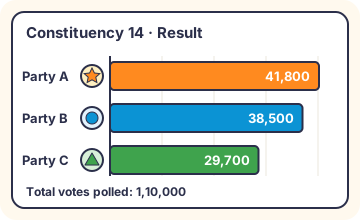
Constituency 14 elects its member by FPTP. Using the result board, who wins, and with what share of the votes polled?
- Party A, with 38% of the votes polled
- Nobody yet. A second round is needed because no one crossed 50%
- Party A, with 41.8% of the votes polled
- Party A, with 62% of the votes polled
Show the answer
A. Party A, with 38% of the votes polled
Under FPTP the highest vote total wins, so Party A (41,800) wins. Its share is . A run-off at 50% belongs to the majority system, not FPTP. 41.8% comes from wrongly dividing by 1,00,000. 62% is the share of votes against A ().
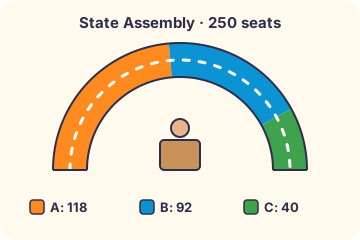
A State Assembly has 250 seats. Party A won 118, Party B 92 and Party C 40. To form a government on its own, a party needs a majority. How many more seats would Party A have needed?
- 7 more
- 8 more
- 49 more
- None, because the largest party always governs alone
Show the answer
B. 8 more
A majority means more than half: half of 250 is 125, so the majority mark is . Party A needs more seats. '7' uses 125, which is only a tie, not a majority. '49' uses a two-thirds mark (). Being the largest party is not enough: without 126 seats, A would need support from others, as in a coalition.
Topics covered
- Why do elections matter?
- Direct and indirect elections
- Importance of elections
- Don't Miss Out: psephology
- The electoral system
- Electoral systems compared
- First-Past-The-Post
- Calculation: FPTP winner
- Calculation: margin of victory
- Proportional representation
- Calculation: seats under PR
- Calculation: majority mark
- Bicameral state legislatures
- Vidhan Parishad
- Calculation: STV quota
- Single transferable vote
- The laws governing elections
- Electoral offences and corrupt practices
- Delimitation
- Delimitation Commission
- Election Commission of India
- Election machinery
- Preparing the electoral roll
- Special Intensive Revision (SIR)
- Deciding the election schedule
- Stages of an election
- ECI and political parties
- Digital ecosystem of the ECI
- No voter to be left behind
- Voting from home
- Don't Miss Out: IEVP
- At the polling station
- EVM and VVPAT
- Steps of voting
- Calculation: voter turnout
- Case study: Ishani votes
- Model Code of Conduct
- Role of political parties
- Importance of political parties
- Defection and the Anti-Defection Law
- Recognition of political parties
- Milestones in India's electoral history
- Challenges to free and fair elections
- Case: comparing three countries