Democracy: CBSE Class 9 Politics practice questions
Practise 50 questions on Democracy, free, with an explanation for each answer.
Sample questions
Your teacher asks the class to sum up what democracy means. Which answer matches the chapter best?

- A system in which one ruler holds all power and decides for everyone
- A government whose power comes from citizens, who elect representatives
- A government in which only educated or wealthy people may vote
- A form of government in which the courts make all the laws
Show the answer
B. A government whose power comes from citizens, who elect representatives
In a democracy the source of power and authority lies with the citizens, who elect representatives through free and fair elections. It rests on freedom, equality, justice, rights and duties, so citizens can vote, express opinions and take part in decisions. Rule by one person is the opposite. Voting is not limited to the educated or the rich, and courts interpret laws rather than make them.
The Constituent Assembly was formed in 1946. Dr B.R. Ambedkar was the Chairman of its Drafting Committee. The Assembly drafted the world's longest written Constitution. How long did the drafting take?

- 11 months and 18 days
- Exactly 4 years, from 1946 to 1950
- 2 years, 11 months and 18 days
- 5 years and 6 months
Show the answer
C. 2 years, 11 months and 18 days
The Assembly took 2 years, 11 months and 18 days to draft the world's longest written Constitution. Counting from 1946 to 1950 confuses the drafting time with the date the Constitution came into force. Its debates (the CAD) drew on India's own democratic traditions and on democratic values from around the world, which made the Constitution robust, flexible, transformative and responsive.
In a 250-seat house, Party A has won only 110 seats. At least how many more seats must it gain from allies to form a coalition government?
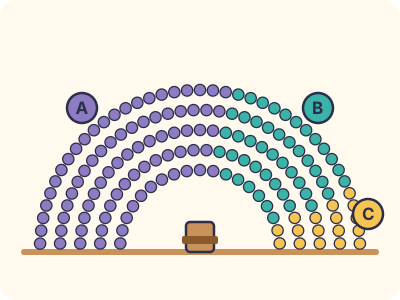
- 15
- 30
- 57
- 16
Show the answer
D. 16
More than 50% of 250 means more than 125, so at least 126 seats. 16. 15 only reaches 125, which is exactly half. 30 assumes all of another party must join, but 16 seats are enough. 57 aims for a two-thirds majority (), which is not needed. The chapter says a coalition of parties with more than 50% of the seats can form the government.
Topics covered
- Meaning of democracy
- The Constitution of India
- Democratic traditions from early times
- Bauddha Saṁgha
- Colonial rule and the freedom struggle
- Evolution of democratic ideas
- Milestones of Indian democracy
- The Constituent Assembly
- A flexible Constitution
- Popular sovereignty
- Universal Adult Franchise
- Representative democracy
- Separation of powers
- Rule of Law
- Fundamental Rights
- Right to Education
- Checks and balances
- Accountability and transparency
- Processes, institutions and values
- Multi-party system
- Majority in a legislature
- India's living democracy
- Safeguarding vulnerable groups
- Role of media
- Types of democracy
- Democracies around the world
- Youth for Democracy festival
- Let's Explore: neighbouring countries
- Voter turnout
- Three-tier system
- Protecting tribal heritage
- Case study: grassroots democracy
- Democracy beyond elections
- Women's reservation in local bodies
- Women and the right to vote
- Right to Information Act
- Challenges to democracy
- The Emergency, 1975–77
- Democracy and you
- Democracy in everyday life