Exploring Mixtures and their Separation: CBSE Class 9 Chemistry practice questions
Practise 50 questions on Exploring Mixtures and their Separation, free, with an explanation for each answer.
Sample questions
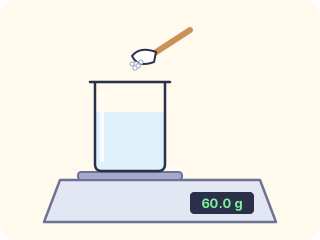
Riya dissolves of sugar in of water. What is the concentration of the solution as a mass by mass percentage?
Show the answer
A.
Mass of solution . Dividing by the water alone (60 g) gives the trap answer 25%, and dividing the water by the sugar () gives 400%. 15% just repeats the mass of sugar, which would only be right if the solution weighed exactly 100 g.
Which list marks every mixture correctly as homogeneous (Hm) or heterogeneous (Ht)?
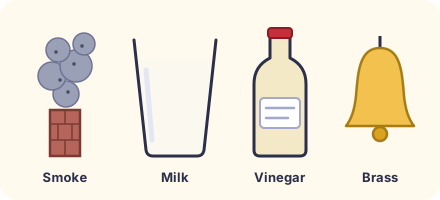
- Air — Hm, Milk — Ht, Sugar solution — Hm, Smoke — Hm
- Brass — Ht, Fog — Ht, Vinegar — Ht, Muddy water — Hm
- Copper sulfate solution — Hm, Salt solution — Hm, Milk — Hm, Bronze — Hm
- Muddy water — Ht, Milk — Ht, Blood — Ht, Brass — Hm
Show the answer
D. Muddy water — Ht, Milk — Ht, Blood — Ht, Brass — Hm
Muddy water is a suspension, and milk and blood are colloids. All three are heterogeneous, even though milk and blood look uniform: their particles scatter light. Brass is an alloy, which is a homogeneous mixture of copper and zinc. List A wrongly calls smoke (solid particles in air) homogeneous. List B gets brass, vinegar and muddy water wrong. List C calls milk homogeneous.
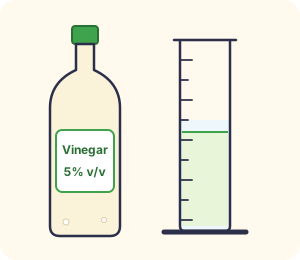
Vinegar is 5% v/v acetic acid. Glacial acetic acid is pure (100%) acetic acid. How should you make of vinegar from glacial acetic acid?
- Add 5 mL of glacial acetic acid to 500 mL of water
- Measure 25 mL of glacial acetic acid and add water until the total volume is 500 mL
- Mix 100 mL of glacial acetic acid with 400 mL of water
- Add 25 mL of glacial acetic acid to 500 mL of water
Show the answer
B. Measure 25 mL of glacial acetic acid and add water until the total volume is 500 mL
Volume of acid needed . The water must bring the total to 500 mL. Adding 25 mL of acid to 500 mL of water makes about 525 mL, which is only about 4.8% v/v. 5 mL wrongly reads "5%" as 5 mL, and 100 mL in 500 mL would make a 20% solution.
Topics covered
- Homogeneous and heterogeneous mixtures
- Classifying mixtures
- Mixtures with a gas
- Tyndall effect
- Mass by mass percentage
- Concentration of a solid mixture
- Mass by volume percentage
- Volume by volume percentage
- Volume of solute needed
- Preparing a solution of given % v/v
- Comparing concentrations
- ORS and concentration
- Solubility curves
- Crystallization from a solubility curve
- Solubility table
- Crystallization of copper sulfate
- Crystal size
- Salt from seawater
- Distillation apparatus
- Distillation
- Choosing distillation
- Fractional distillation
- Fractions of crude oil
- Deg-Bhapka method
- Paper chromatography
- Evaporation, distillation and chromatography
- Separating funnel
- Sublimation
- Separating a three-part mixture
- Alloys
- Composition of an alloy
- Separation processes
- Filtration
- Limits of filtration
- Centrifugation
- Paperfuge
- Coagulation
- Coagulation in daily life
- Components of blood
- Colloids
- Solutions, suspensions and colloids
- Tyndall effect in nature
- Emulsions
- Choosing a separation method