Atomic Foundations of Matter: CBSE Class 9 Chemistry practice questions
Practise 50 questions on Atomic Foundations of Matter, free, with an explanation for each answer.
Sample questions
Baking soda is added to vinegar in an open flask kept on a digital balance. After the fizzing stops, the reading is lower than at the start. Why?
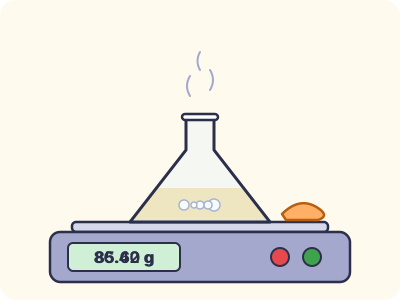
- Some mass was destroyed during the reaction
- Carbon dioxide gas escaped into the air from the open flask
- A balance always reads lower after any reaction
- Baking soda loses all its mass once it reacts
Show the answer
B. Carbon dioxide gas escaped into the air from the open flask
Vinegar and baking soda react to form carbon dioxide gas and other substances. In an open flask the gas escapes into the air, so it is no longer weighed and the reading drops. No mass is destroyed: when the balloon traps the gas, the reading stays the same.
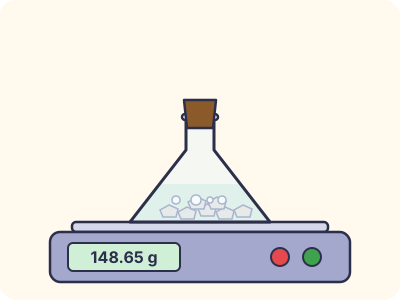
In a closed container, of calcium carbonate reacts completely with of hydrochloric acid. The products are of carbon dioxide, of water and some calcium chloride. What mass of calcium chloride is formed?
Show the answer
D.
Reactants: . By the Law of Conservation of Mass the products also total , so calcium chloride . forgets to subtract the water, forgets the carbon dioxide, and adds every number together.
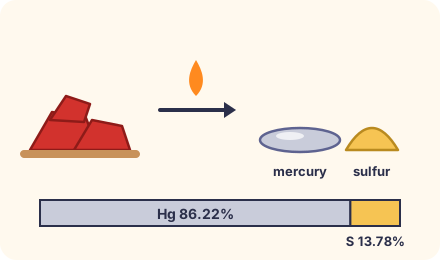
When cinnabar (called hingula in India) is heated, it gives mercury and sulfur in the mass percentages shown. What mass of mercury can be obtained from of pure cinnabar?
Show the answer
A.
Mass of mercury . is the sulfur ( of 50 g), treats the percentage as grams, and divides by 0.8622 instead of multiplying. Because cinnabar is a compound, every pure sample has this same composition.
Topics covered
- Conservation of mass: closed set-up
- Conservation of mass: open set-up
- Mass in a physical change
- Verifying the Law of Conservation of Mass
- Law of Conservation of Mass: calculation
- Conservation of mass: precipitation reaction
- Conservation of mass: burning
- Using fixed masses in a reaction
- Scientists of the chapter
- Law of Constant Proportions
- Law of Constant Proportions: calculation
- Cinnabar and percentage composition
- Compounds and mixtures
- Dalton's Atomic Theory
- Dalton's theory and burning magnesium
- Atoms and molecules
- Molecules of elements and compounds
- Atoms and molecules of oxygen
- Single, double and triple covalent bonds
- Covalent bond in hydrogen chloride
- Covalent compounds with common names
- Molecular mass
- Naming covalent compounds
- Ionic bond: electron transfer
- Atoms and ions
- Formula unit mass and crystal structure
- Chloride ion
- Electrons and neutrons in ions
- Electrons in atoms and ions
- Predicting the bond and formula
- Writing formulae of ionic compounds
- Writing formulae with polyatomic ions
- Balancing charges in ionic compounds
- Common ions
- Combining ions in the right ratio
- Formulae from pairs of ions
- Formula unit mass
- Electrical conductivity of ionic compounds
- Electrical conductivity of covalent compounds
- Conductivity apparatus
- Properties of ionic compounds
- Comparing ionic and covalent compounds
- Bridging Science and Society: nuclear energy
- Predicting properties from electron arrangement