Chemical Reactions and Equations: CBSE Class 10 Chemistry practice questions
Practise 50 questions on Chemical Reactions and Equations, free, with an explanation for each answer.
Sample questions
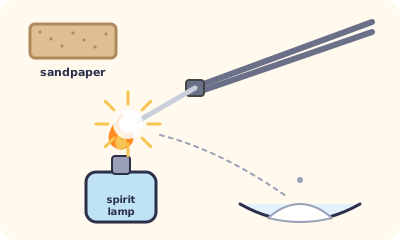
In Activity 1.1 a cleaned magnesium ribbon is held in a flame. Which observation shows that a chemical reaction has taken place?
- The ribbon becomes hot when it is held in the flame
- The ribbon is cut into a piece 3 to 4 cm long
- It burns with a dazzling white flame and leaves a new white powder, magnesium oxide
- The ash is collected in a watch-glass
Show the answer
C. It burns with a dazzling white flame and leaves a new white powder, magnesium oxide
A chemical change forms new substances. Burning magnesium makes a white powder, magnesium oxide, which is nothing like the shiny metal. Heating alone does not prove a reaction, and cutting the ribbon or collecting the ash are just steps in the procedure.
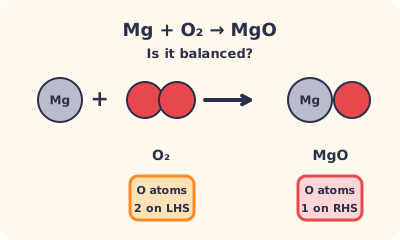
The skeletal equation for burning magnesium is . Why is it not balanced?
- It has 1 magnesium atom on the left but 2 on the right
- The oxygen molecule should be written as O instead of O₂
- The product should be written as MgO₂
- It has 2 oxygen atoms on the left but only 1 on the right
Show the answer
D. It has 2 oxygen atoms on the left but only 1 on the right
Magnesium has 1 atom on each side, but oxygen has 2 on the left (in O₂) and 1 on the right (in MgO). Never fix this by changing formulae, because O₂ and MgO are correct. Put coefficients instead: .
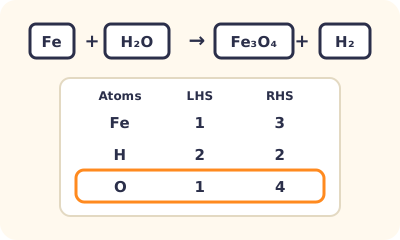
Which of these is the correctly balanced equation for iron reacting with steam?
Show the answer
B.
Only has 3 Fe, 8 H and 4 O on each side. The first wrong option leaves hydrogen 8 on the left and 2 on the right. The second has 1 Fe against 3. The third has only 2 O against 4.
Topics covered
- Chemical change
- Writing chemical equations
- Balanced chemical equations
- Physical states
- Combination reaction
- Exothermic reactions
- Decomposition reaction
- Endothermic and exothermic
- Displacement reaction
- Double displacement reaction
- Types of reaction
- Oxidation and reduction
- Everyday oxidation
- Corrosion
- Rancidity
- Corrosion and rancidity