Acids, Bases and Salts: CBSE Class 10 Chemistry practice questions
Practise 50 questions on Acids, Bases and Salts, free, with an explanation for each answer.
Sample questions
Why should curd and other sour substances not be kept in brass or copper vessels?
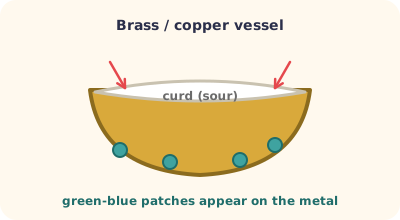
- Metals absorb the sour taste and make the curd sweet
- The acids in them react with the metal to form harmful metal salts
- Sour substances turn basic in a metal vessel
- The metal only gets scratched and nothing else changes
Show the answer
B. The acids in them react with the metal to form harmful metal salts
Curd and sour substances contain acids (such as lactic or citric acid). Acids react with metals such as copper and the metals in brass to form salts, which can be harmful and spoil the food. This is why such food is not kept in these vessels.
You have three test tubes. They contain distilled water, an acidic solution and a basic solution, but you do not know which is which. You only have red litmus paper. It turns blue in tube 2 only. How can you find out which of tubes 1 and 3 has the acid?
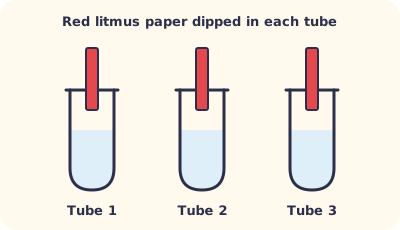
- Dip a fresh red litmus paper again in tubes 1 and 3: the one where it becomes a deeper red is the acid
- Taste a drop from tubes 1 and 3: the sour one is the acid
- Dip the blue litmus paper obtained from tube 2 into tubes 1 and 3: it turns red in the acidic solution and stays blue in water
- Add a drop of tube 2 to tubes 1 and 3: the one that turns blue is the acid
Show the answer
C. Dip the blue litmus paper obtained from tube 2 into tubes 1 and 3: it turns red in the acidic solution and stays blue in water
Tube 2 is the base because it turns red litmus blue. The red litmus now has a blue paper that can test the others: acids turn blue litmus red, while water leaves it unchanged. Red litmus alone cannot show an acid, since it stays red in acid and in water. Tasting chemicals is never safe, and adding the base to the others with no indicator shows nothing.
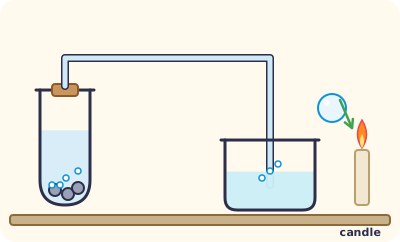
Aluminium powder reacts with dilute sulphuric acid to give aluminium sulphate and hydrogen gas. Which balanced equation is correct?
Show the answer
B.
With and the salt is (2 Al, 3 sulphate), so 3 are needed, giving 3 . Common traps: writing or (charges ignored) and leaving hydrogen unbalanced with a single .
Topics covered
- Acid-base indicators
- Olfactory indicators
- Acids and metals
- Soda-acid fire extinguisher
- Metal carbonates and acids
- Reactions of acids
- Neutralisation
- Metal oxides and non-metal oxides
- Ions in acids and bases
- Dilution
- pH scale
- Strength of acids and bases
- pH in everyday life
- Natural acids
- Chemicals from common salt
- Salts
- Water of crystallisation