Carbon and its Compounds: CBSE Class 10 Chemistry practice questions
Practise 50 questions on Carbon and its Compounds, free, with an explanation for each answer.
Sample questions
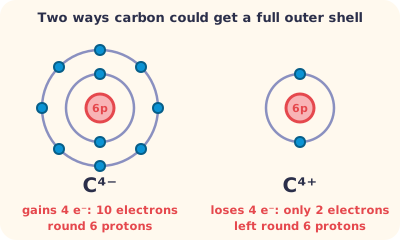
A carbon atom has 4 valence electrons. To get a noble gas configuration, it could gain four electrons or lose four electrons. Why does carbon not do this?
- Carbon already has a completely filled outer shell, so it never forms bonds
- Carbon has six valence electrons, so it only needs to gain two, which is easy
- Gaining or losing four electrons is very hard, so carbon shares electrons
- Electrons can never be shared between atoms in a molecule
Show the answer
C. Gaining or losing four electrons is very hard, so carbon shares electrons
Carbon (atomic number 6, configuration 2, 4) would have to gain four electrons, but a nucleus of 6 protons cannot easily hold 10 electrons; or it would have to lose four electrons, which needs a huge amount of energy and leaves just 2 electrons round 6 protons. So carbon shares its valence electrons with other atoms and forms covalent bonds. Carbon has 4 (not 6) valence electrons, its outer shell is not full, and electron sharing is exactly how many molecules form.
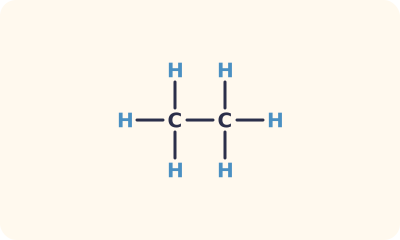
Ethane has the molecular formula . How many covalent bonds does it have?
- 6
- 7
- 8
- 9
Show the answer
B. 7
In the structure of ethane there are six C-H single bonds (three on each carbon) and one C-C single bond, so 7 bonds in all. The common trap is to count only the six C-H bonds and forget the C-C bond (answer 6). Counts of 8 or 9 over-count the bonds.
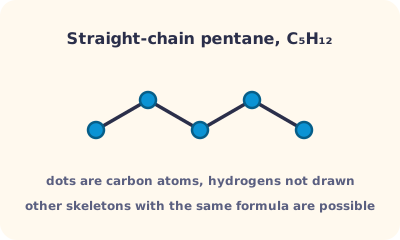
Pentane is . How many structural isomers can be drawn for it? (Count straight-chain pentane also.)
- 2
- 3
- 4
- 5
Show the answer
B. 3
Pentane has three structural isomers: straight-chain pentane, 2-methylbutane (a four-carbon chain with one methyl branch) and 2,2-dimethylpropane (a central carbon with four other carbons). The trap is counting the same skeleton drawn bent in a different way as a new isomer.
Topics covered
- Bonding in carbon: the covalent bond
- Properties of covalent compounds
- Allotropes of carbon
- Versatile nature of carbon
- Saturated and unsaturated compounds
- Homologous series
- Chains, branches and rings
- Functional groups
- Nomenclature of carbon compounds
- Combustion
- Oxidation
- Addition reaction
- Substitution reaction
- Ethanol
- Ethanoic acid
- Reactions of ethanol and ethanoic acid
- Soaps and detergents